
Table of Contents
What is a Payslip?
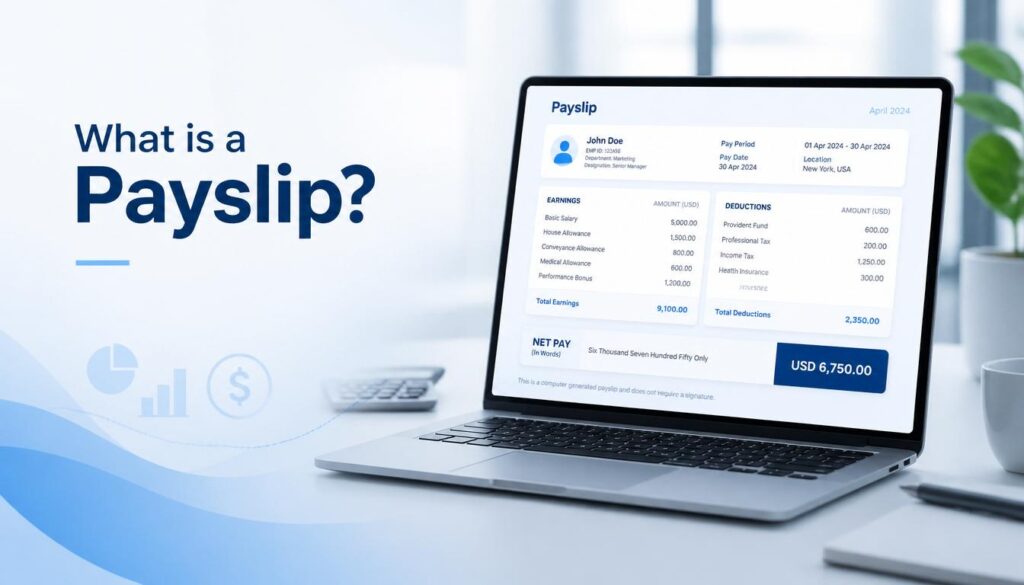
A payslip also called a salary slip, pay stub, or wage slip is a document your employer provides that details exactly how your pay for a specific period has been calculated. It shows what you earned, what was deducted, and what you actually received in your bank account. This guide explains every component of a payslip, why it matters, and where to get one if you need it.
What is a payslip used for?
Your payslip is one of the most important financial documents you receive regularly. Here are the situations where you will need it:
- Applying for a loan or mortgage – lenders require proof of income
- Applying for a rental property – landlords verify income before signing a tenancy
- Visa applications – immigration authorities often require payslips as proof of employment
- Tax filing – payslips help you verify the income and deductions reported by your employer
- Disputing a pay error – if you believe you have been underpaid, the payslip is the reference document
- Applying for benefits or government assistance – proof of income is required
- Opening a bank account — some banks require payslips to verify employment
What does a payslip include?
Employee and employer details
Every payslip must show your full name, your employee ID or reference number, your job title, your department, your employer’s name and address, and the pay period the payslip covers typically a month, a week, or a fortnight.
Gross pay
Gross pay is your total earnings before any deductions are applied. It includes your basic salary plus any additional payments such as overtime pay, performance bonuses, commission, housing allowance, and transport allowance. Gross pay is the number that represents your total cost to the employer.
Deductions
Deductions are amounts subtracted from your gross pay before you receive your money. Common deductions include: income tax (calculated based on your earnings and tax code), national insurance or social security contributions, pension or provident fund contributions, health insurance premiums, and any loan repayments deducted at source.
Net pay
Net pay is your take home pay what actually arrives in your bank account. It is calculated as gross pay minus total deductions. Net pay is the number most people focus on day to day, though understanding the gross pay and deductions is important for tax and financial planning.
Pay period and payment date
The pay period shows the start and end date of the work period covered by this payslip. The payment date shows when the salary was or will be transferred to your account. These two dates are often different for example, a payslip might cover the month of March but be paid on the 1st of April.
Year to date figures
Many payslips also include year to date (YTD) totals the cumulative gross pay, total deductions, and total net pay from the start of the financial year to date. These are useful for tax calculations and for tracking your total earnings across the year.
Are employers legally required to provide payslips?
In most countries, yes. In the United Kingdom, employers are legally required under the Employment Rights Act to provide a written payslip to all employees on or before the day of payment. In India, the Payment of Wages Act requires employers to provide wage slips. In Pakistan, labour laws require payslip documentation for salaried employees. In the UAE, the Wage Protection System mandates salary payment records. In the United States, requirements vary by state some states mandate written pay stubs while others do not. Check your local employment law for the specific requirements in your jurisdiction.
What if my employer hasn’t given me a payslip?
If your employer has not provided a payslip and is legally required to do so, you can formally request one in writing. If your employer continues to refuse, you may be able to escalate to your country’s labour authority or employment tribunal.
If you urgently need a payslip for a visa application or loan, for example and your employer cannot provide one quickly, you can create a professional payslip based on your own salary information using the TechTester free payslip generator at techtester.online/payslip-generator/. The tool calculates gross pay, deductions, and net pay automatically and downloads a clean PDF.
Digital vs paper payslips
Most employers now provide payslips digitally either by email, through an employee self service portal, or via payroll software. Digital payslips have the same legal standing as paper payslips in most countries. If you need a paper copy of a digital payslip, simply print it or use a tool like TechTester’s payslip generator to create a print-ready PDF version.
How to read your payslip
When you receive a payslip, check these things first: confirm your name and employee details are correct, verify the pay period matches the period you worked, check that gross pay matches your expected salary plus any additional earnings, review each deduction individually and confirm the amounts are correct, and confirm that net pay equals gross pay minus the total of all deductions. If any figure does not match your expectations, raise it with your payroll or HR department before the next pay period.
Need to create a payslip quickly? Use the TechTester free payslip generator – no signup, downloads as PDF in under 60 seconds: techtester.online/payslip-generator/
Pingback: Why Businesses Are Switching to Online Payslip Generators – beegamer0